Beyond Buyer’s vs. Seller’s:
Understanding Today’s Real Estate Market
One of the most common questions in real estate is whether the market favors buyers or sellers. The honest answer is rarely simple. Today’s market doesn’t fit neatly into a single category, and broad labels often miss what’s really happening on the ground. While headlines may suggest one trend or another, real-world outcomes are shaped by a far more nuanced set of factors.

In practice, results depend on location, price range, property condition, timing, and—most importantly—preparation. Each of these elements plays a role in how a home is received by the market. A well-positioned property that reflects current buyer expectations can generate strong interest, even in a shifting or uncertain environment. At the same time, a home that misses the mark in pricing or presentation may require patience and strategic adjustment to achieve the desired outcome.
In this environment, some homes attract immediate attention, multiple showings, and confident offers, while others take longer to gain traction. Two properties on the same street can experience entirely different results based solely on pricing strategy, level of preparation, and how clearly the value is communicated to buyers. This is why understanding the specifics of a property and its market context matters far more than relying on generalized market descriptions.Today’s market doesn’t fit neatly into a single category. Instead, outcomes depend on location, price range, condition, and preparation. Some homes attract immediate interest, while others require patience and a bit of adjustment.
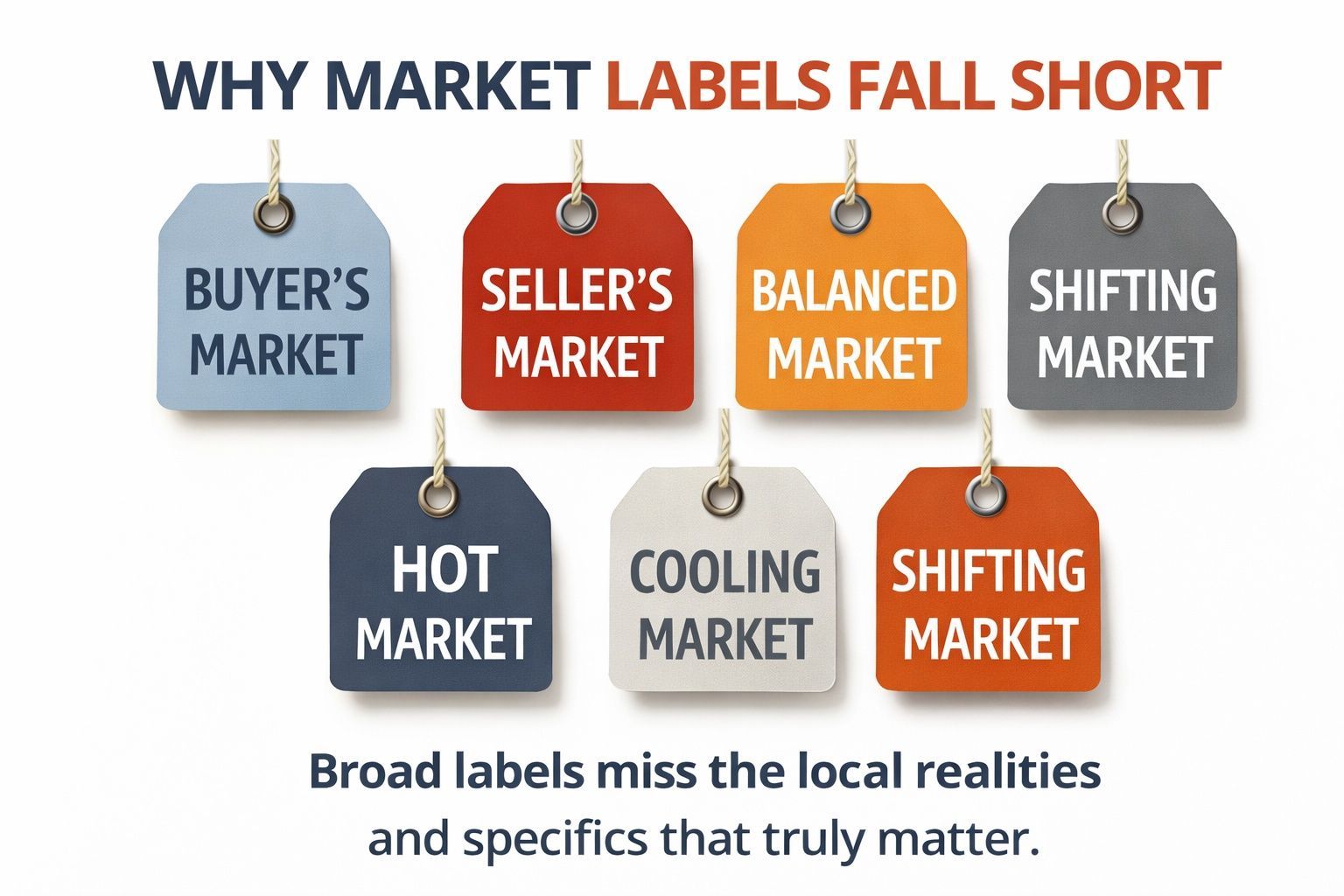
WHY LABELS FALL SHORT
Terms like “buyer’s market” or “seller’s market” oversimplify what is actually a layered and highly localized landscape. A well-priced, well-presented home in a desirable area may still behave like a seller’s market, drawing motivated buyers who are ready to act. Meanwhile, a home that is overpriced, underprepared, or poorly positioned may feel like a buyer’s market—leading to negotiations, extended time on market, or reduced momentum.
Both realities can exist at the same time, often within the same neighborhood or even within the same price range. Market conditions are rarely uniform, and treating them as such can lead to missed opportunities or unrealistic expectations.
OPPORTUNITY ON BOTH SIDES
Buyers today often benefit from increased choice and more time to evaluate options, allowing for thoughtful, informed decisions rather than rushed ones. This can create space for careful consideration of lifestyle, location, and long-term goals. Sellers, on the other hand, see the strongest results when expectations are aligned with current conditions and when thoughtful attention is given to pricing, presentation, and strategic marketing.
This market rewards preparation rather than assumptions. Success comes from understanding the specific dynamics at play and responding with clarity, flexibility, and intention. When buyers and sellers approach the process with realistic expectations and expert guidance, opportunities emerge even in a complex environment.
Ultimately, recognizing where opportunity exists—rather than forcing the market into a simple label—leads to better decisions, smoother transactions, and stronger outcomes for everyone involved.

“If you’d like to discuss this further, call or text me at 541-301-3435, or visit OregonHomes.io to start your home search today.”